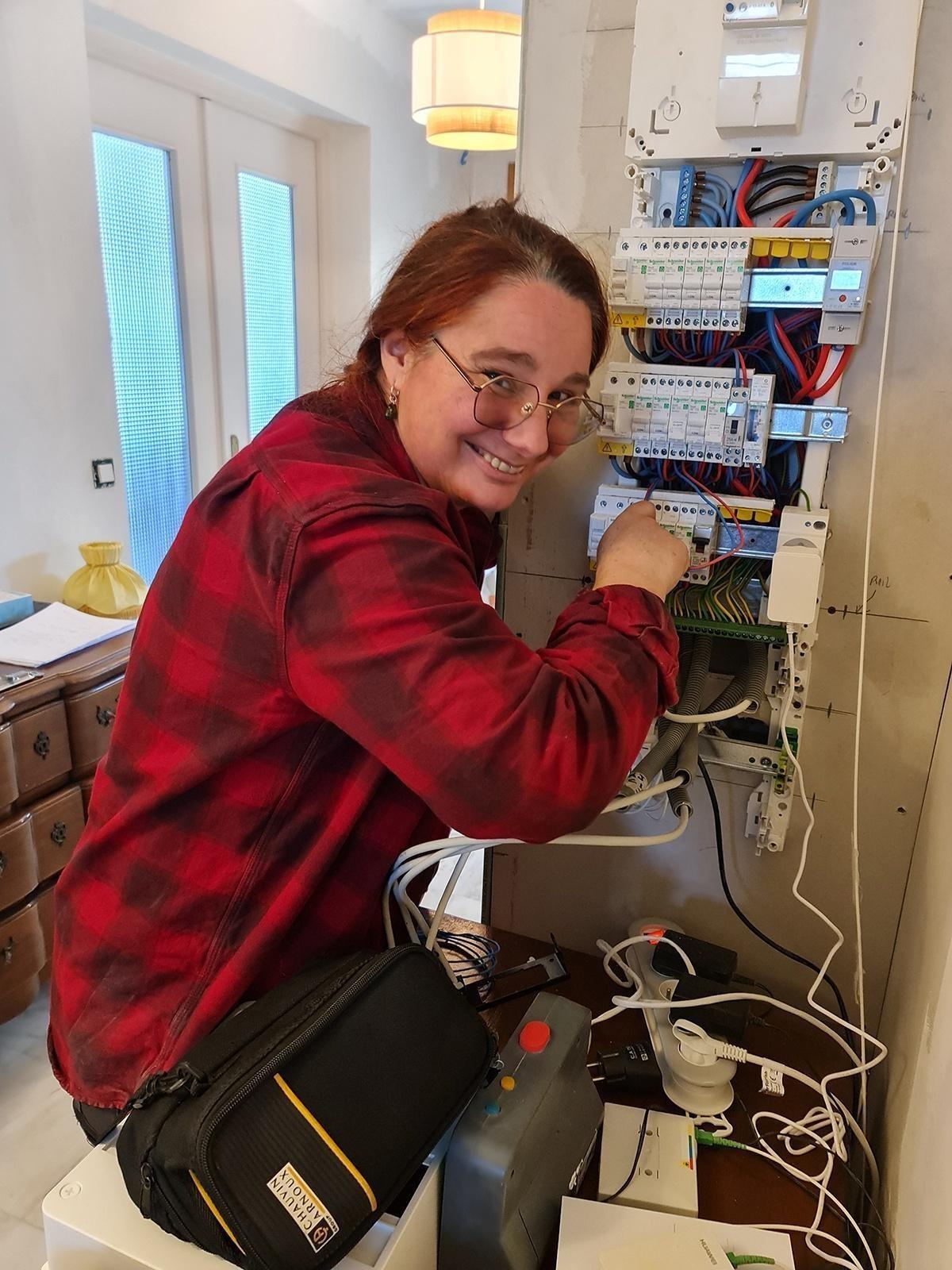
She spent her youth moving regularly with her mother, originally a schoolteacher who took charge of her children’s education at home. “When we came back to France from Italy, I was 14 years old, and the teachers didn’t know what to do with me because I was trilingual but hopeless at maths. They put me on a hairdressing apprenticeship because I was a girl,” explains Nathalie Frappart ironically, “I was neither sociable nor attached to appearances, so I spent a year at the back of the shop studying the pH levels of hair dye!” Her enthusiasm for science eventually led to her being accepted as an apprentice by an electrician. “I discovered the world of construction, and I liked it! I joined a leading-edge company in the home automation and alarm sector after that and gained higher qualifications.” During the 18 years she spent there, the electrician trained apprentices and interns. She enjoyed passing on her knowledge and ended up becoming a full-time trainer in home automation, without reckoning on her hyperactivity: “Coming to work every day with the same people, in the same place, I was foaming at the mouth to such an extent that I compensated for it with mountain sports, climbing and canyoning.” It was only in 2012 that she finally set up her own business!
ROLLING UP HER SLEEVES
Now with an apprentice, the electrician would like to recruit, but this does not seem to be particularly easy: “I specialise in the industry and service sectors; so I can work in establishments for the disabled just as much as waste reprocessing plants. So, it is very specialised and when people acquire skills, they don’t want to get their hands dirty anymore.” She is involved with the electricians’ unions and campaigns in schools for parity and female entrepreneurship with the Femmes Chefs d’Entreprises network and the 100,000 Entrepreneurs association. Is there anything that she takes pride in at the moment? “My daughter, who is a nurse, is finishing a farmer’s house and doing the wallpapering, tiling, and plumbing her-self. When men only passon these practical skillsto their sons, they deprive women of essential exper-tise, including how to run a business.”























 Côteweb 2021, création de site Internet sur Nice