


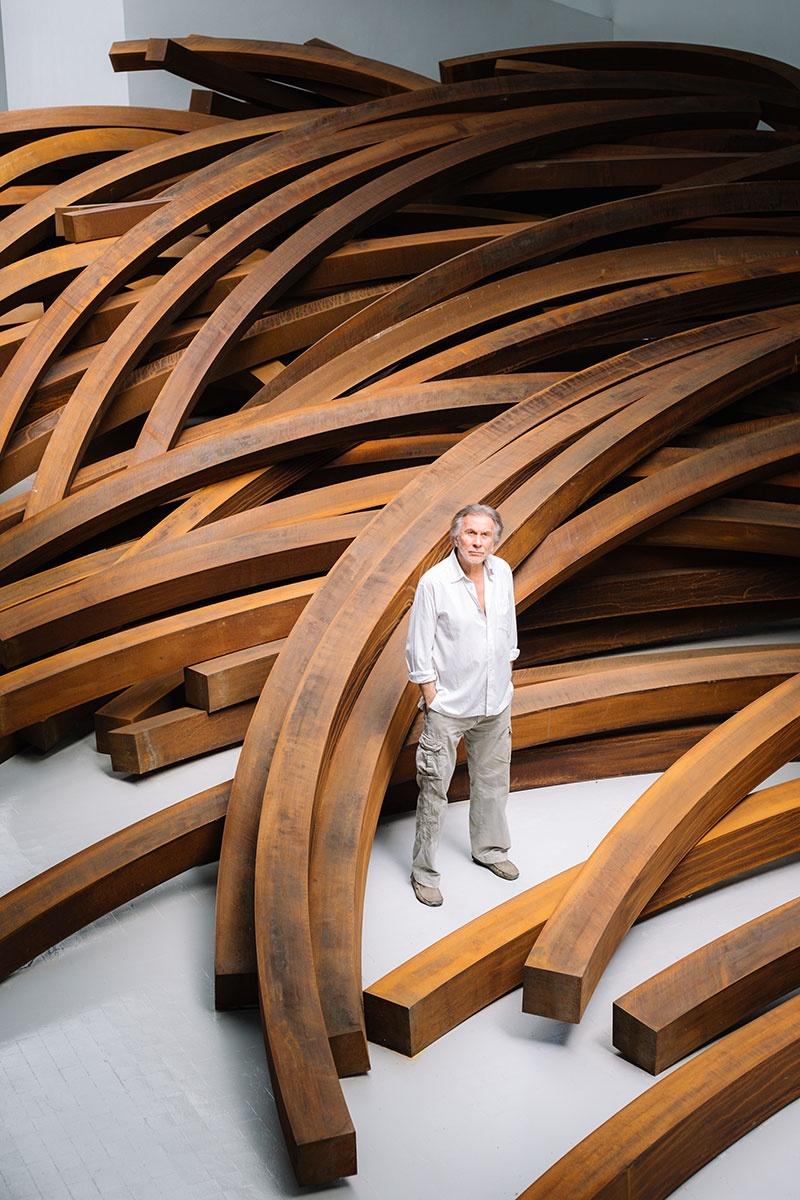
His huge sculptures can be seen from New York to Seoul, including in Nice's Albert Ier Gardens. Close-up of a major French artist whose work is above all conceptual.
Bernar Venet is a busy man, with exhibitions this summer in Dubai, Madrid, Paris, New York and Mouans-Sartoux, not to mention six books coming out on his work. "My entire activity has been about fighting influences," states an artist who makes no concessions, even dropping the "d" from his first name to underline his radical approach. His sculptures are like autonomous signs in the urban landscape, but before using steel he worked with numerous other materials; painting, performance, music and poetry are all part of his decompartmentalised field of experimentation. The exhibition at L'Espace de l’Art Concret until 13 November looks back to his beginnings, from 1961 to when he moved to New York in 1966. Over that period he produced the Cardboard Reliefs, of which we can see the largest number ever shown together here. He was establishing his bases.
A streak of tar
Bernar Venet was born in 1941 in the working-class town of Château-Arnoux-Saint-Auban. Aged 17 he came to Nice and studied at Villa Thiole art school, where he made an impression, then worked as assistant stage designer at the Nice opera house. In 1961 he was called up for military service and while at Carpiagne army camp noticed a streak of tar running down the side of a quarry. "I was struck by that natural occurrence to which gravity had given form, and by the material's rich possibilities," the artist remembers. Exempted from arms training and fatigues, he was handed a fantastic opportunity in the shape of an 800m² attic to use as a studio. "I kept up with what Rauschenberg, a precursor of Pop Art, was doing in the States and the Nouveaux Réalistes in France," he tells us, "but I was much younger than them and no way was I going to jump on their bandwagon." Practising a hard-line abstract art, Venet wasn't out to be commercial. With a sort of uncontrolled spontaneity he produced gestural works out of pieces of old cardboard on which he spread tar with his feet. He gave his first performance lying amidst rubbish and recorded the sound of a wheelbarrow crossing the barracks courtyard.
Detachment from the object
"In 1963 Venet returned to Nice and set up his studio at 18 Rue Pairolière. These were difficult times, even if he did become friends with Arman. "I used to lend him a hand. I was only 22 and flattered because he was already the tops. There was Yves Klein too, who didn't see himself as a painter and was always talking about going beyond the art problem." Venet quickly integrated the possibility of exploring different disciplines to express one work ethic. Although he had friends among the Nouveaux Réalistes, he didn't identify with their assemblages and accumulations of everyday objects. And there remained one field he hadn't so far explored: sculpture. "Walking along Avenue de Verdun one day I came across a pile of gravel mixed with tar. I'd just given up on the flatness of canvas and there I saw my work in 3D." So he made an artwork with pieces of coal, which were taken away after the exhibition. The installation had no specific shape or volume imposed on it, it was simply a pile subject to gravity, a concept with a life of its own, an ephemeral result freed of fetishism. One that anyone could reproduce.
The random and the mathematical
That distancing from the work and its crafting is omnipresent in Venet's oeuvre, challenging visitors even at the entrance to his Foundation in Le Muy, where a huge Effondrement of steel girders greets them. The place echoes his New York Foundation where he has been displaying his works and collection for the last seven years. "I owe everything to the States. France never did anything for me since at the time no gallery would show my work," the artist remembers. Venet didn't identify with Minimalism, which reconnected with simple shapes but remained generally geometrical; later on his art was classed as conceptual. A close friend of Gottfried Honegger, the originator of L'Espace de l’Art Concret, Venet similarly distanced himself from that tendency to focus on line, colour and surface. "My art was more concrete, if you like, than Honegger's. I poured tar and I showed coal, with no pretensions," he says. Having reached such a radical point, he ceased working completely from 1971 to 1976. His art would be reborn with the Indeterminate Lines, Angles and Arcs that led him to increasingly huge creations.
Espace de l'Art Concret, Château de Mouans
Mouans-Sartoux
Tél. : 04 93 75 71 50.
www.espacedelartconcret.fr
Par Tanja Stojanov - Portrait : Sophie Boulet









 Côteweb 2021, création de site Internet sur Nice