


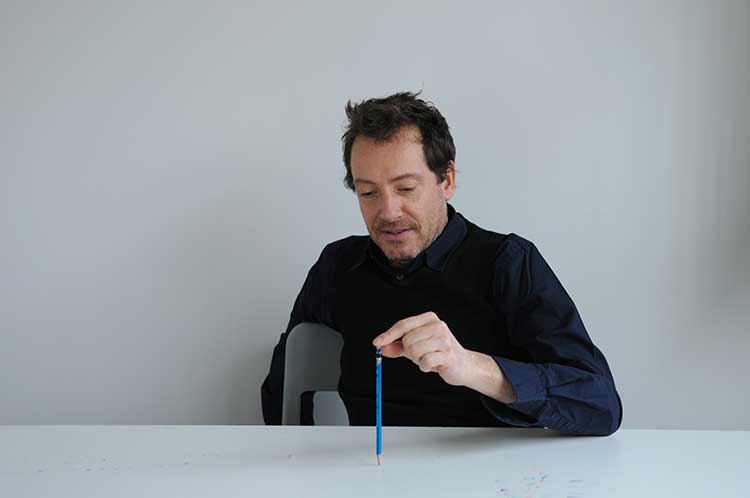
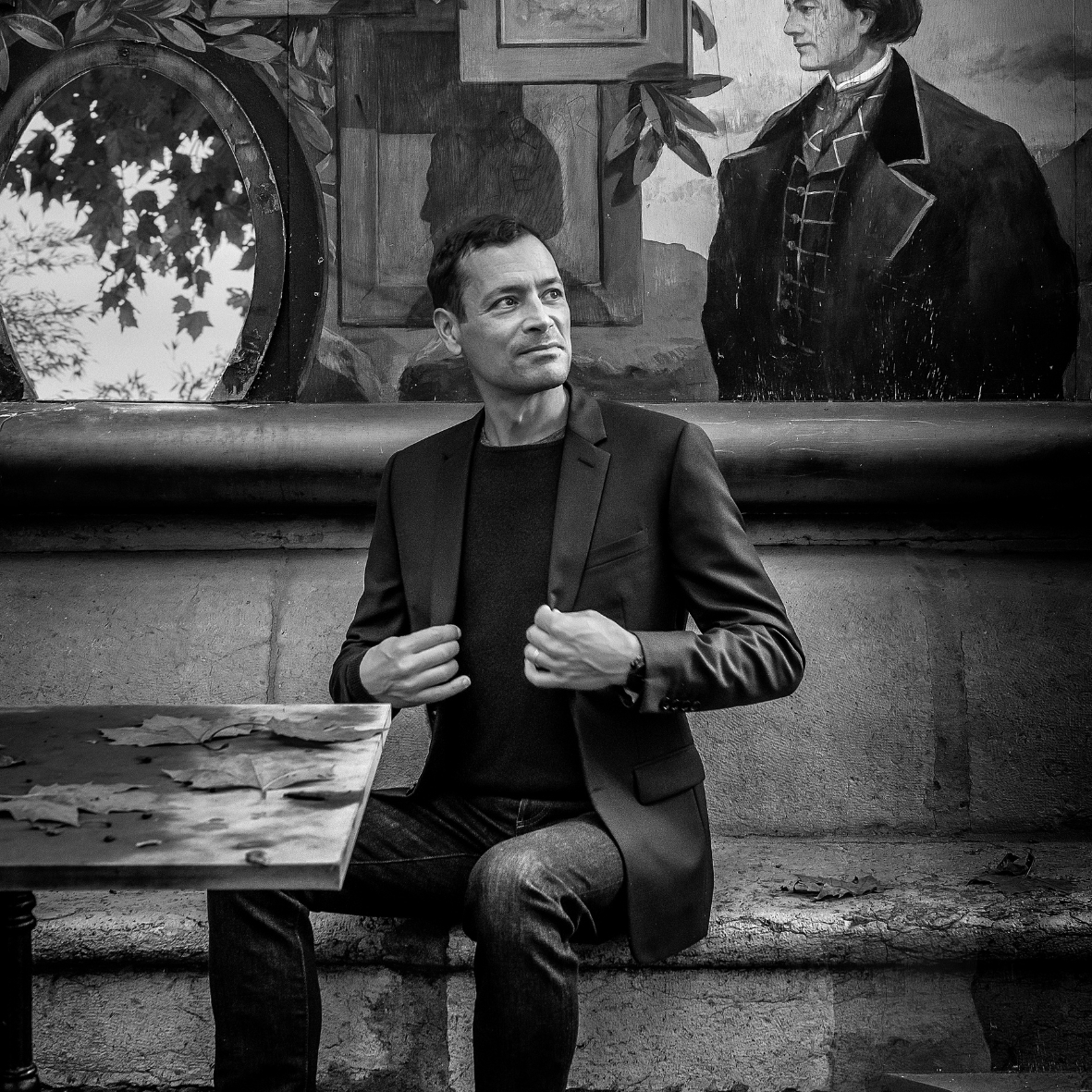
The Frenchman was named the Maison & Objet show's Designer of the Year. We meet an artist, designer and scenographer seeking the essential.
Why do you never refer to function when talking about your projects?
Because I work a lot on objects whose function is already defined. When I design a basket for Alessi I'm not looking to reinvent the basket, what interests me is thinking about a product that has come down through history so has changed over the years. That way I try to keep as close as possible to the idea of a basket. The function is inherent in the initial premise.
So you concentrate on basic form?
Exactly. Drawing is an integral part of that and the basis of my work method, where everything starts. It enables me to eliminate things; I sketch repetitively, always on loose sheets, never in sketchbooks, so at the end of each day I can sort what I've done and throw out what doesn't work. Drawing serves to clear my mind of clutter and so move towards an ever simpler form.
Did that direct your work at the CIRVA* in 1998 and 2001?
Yes. At that time I was becoming interested in exploring mechanisms leading to a simplification of the object. Although the flexibility of the material – glass – makes all forms possible, I decided to use one only, the cylinder. Which in a way means working on a very simple form that doesn't belong to me – the cylinder belongs to everyone, it's an archetype.
That project also enabled you to think of objects as intended to interact to create a "landscape".
Yes indeed, you never design an object in a vacuum, even if you devote your entire attention to it. That object will relate to others and create the domestic environments in which we live. In choosing to use only the cylinder in my CIRVA project, I felt it was of greater interest to study how repeating that form could result in finished objects, and that turned into the focus of the project. Afterwards I moved onto thinking and writing about the question of articulation.
Articulation, which also operates between object and user...
Yes. For Hermès, for instance, I designed simple bowls but with a cleft in them. Why? Because I like directional objects: when you set the bowl down you're forced to think about how you position the cleft, so placing and using the object are no longer neutral acts.
Does the same principle apply to your clowns' faces?
Yes. I decorated the vases I created for the Manufacture Nationale de Sèvres porcelain factory with 10 different clowns' faces. And I added an elastic band that "holds" the nose (but in fact serves no purpose) to accentuate the fact that there's a front and a back. Then it's up to the user to decide how they orientate the piece. The question of direction and frontality often crops up in my work.
Last January you presented the PC Lamp deve-loped with Sebastian Wrong, a project that evolved as you worked on it.
Initially Sebastian Wrong suggested I design a small clip lamp that could be sold very cheaply. At that point there was no talk of technology, a LED source or gas-spring articulation, nor indeed investment in extruding aluminium. But in the end each stage brought modifications until a new direction became clear: designing an articulated task lamp of the Anglepoise type. Although it looks very simple, it took three years to finalise because of the complex articulations and invisible technology. It has generated an entire range with table, clip, wall and floor versions
Par Alexandre Benoist
* International research centre for glass and visual arts


 Côteweb 2021, création de site Internet sur Nice