




The regional museum enters into a magical dialogue with the famed couturier's evening gowns, whisking us off on imagined travels to India, Japan and China.
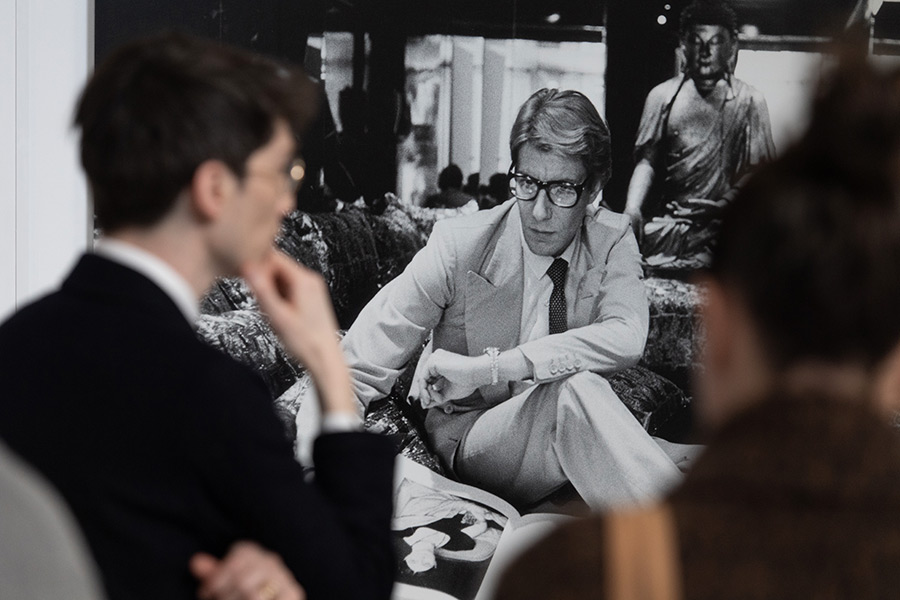
Yves Saint Laurent was passionate about the arts and one of the first fashion designers to give the creations of Mondrian, Poliakoff and Wesselmann a new life on fabric. Born in Algeria, he fell in love with Morocco, where he bought the Villa Majorelle, and dedicated an entire collection to opera and the Ballets Russes. One of his most fruitful sources of inspiration was Asia, a continent whose local traditions and folklores he explored essentially through books, but of course artworks too. "I've visited every country by dreaming," explained the sedentary traveller whose observation of Indian, Chinese and Japanese costume allowed him to deliver a personal vision grounded in considerable knowledge of those countries' history and culture. This exhibition inviting visitors to revel in rich colours, fabrics and designs has been adapted for Nice's Asian Arts Museum from the one shown at the 2017 inauguration of the Yves Saint Laurent Museum in Paris. An encounter with 35 of the couturier's creations, accompanied by sketches, photographs and jewellery.
A maharajah's palace
The India imagined by Saint Laurent embraced the most opulent garments in royal wardrobes through to the traditional saris worn by ordinary Hindu women. For his very first collection in 1962, Saint Laurent reimagined the sumptuous coats that graced North Indian rulers, all delicate silks, precious-metal embroidery and gemstone buttons, while his very last collection in 2002 featured sari-inspired dresses draping the body in unbelievably delicate chiffons.
Manchu dynasty dragons
Although he visited China only once, Saint Laurent travelled the country in his imagination through the artworks he collected with his partner, Pierre Bergé. His "Chinoise" models, their generous proportions accentuating movement, seem to have stepped straight out of the Beijing Opera. From 1970 his fabrics sported floral patterns, with Imperial China paramount in the autumn-winter 1977 collection. That same year he launched his legendary Opium perfume whose advertising campaigns created yearning and scandal in equal measure, the name a nod to love's heady attraction.
Kimonos of silk, gold and silver
Japan wasn't solely a source of inspiration for Saint Laurent, who saw it as something of an example. He paid tribute to the courtesans he observed in the streets of Kyoto's Gion district, and his fascination with kabuki theatre led him to reimagine the kimono in a sophisticated version whose flowing lines embraced the body without constraining it. Endless images of Asia that helped the French couturier invent an utterly original world.
Jusqu'au 6 octobre. Entrée Libre
Musée départemental des Arts asiatiques
405 Promenade des Anglais, Nice
Tél. 04 92 29 37 00
www.arts-asiatiques.com
Par Tanja Stojanov


 Côteweb 2021, création de site Internet sur Nice