




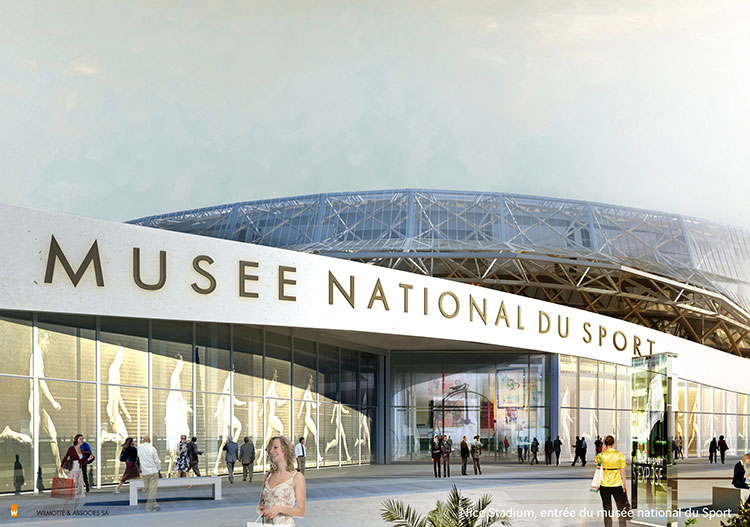
The National Sport Museum, conceived 50 years ago by racing cyclist Jean Durry at the request of sports minister Maurice Herzog, has moved into the Allianz Riviera stadium in Nice.
"After the Louvre Lens and the Beaubourg Metz, this decentralisation is the Ministry for Culture's last big project," explains Marie Grasse, curator of this new Musée National du Sport. "When the question of moving the museum out of Paris arose, several towns came forward and Nice was selected." Why Nice? An obvious choice given how strongly the Riviera's capital engages with sport through its football team and its big sports events such as Ironman and the Paris-Nice cycling race, not forgetting that its mayor and parliamentary deputy, Christian Estrosi, is a former motorbike racing champion. In addition, the construction of the new Allianz Riviera stadium added a further argument to the candidature of "Nissa la Bella" as it presented an opportunity for a tailor-made space to house the museum's considerable collection.
600 years of sporting history
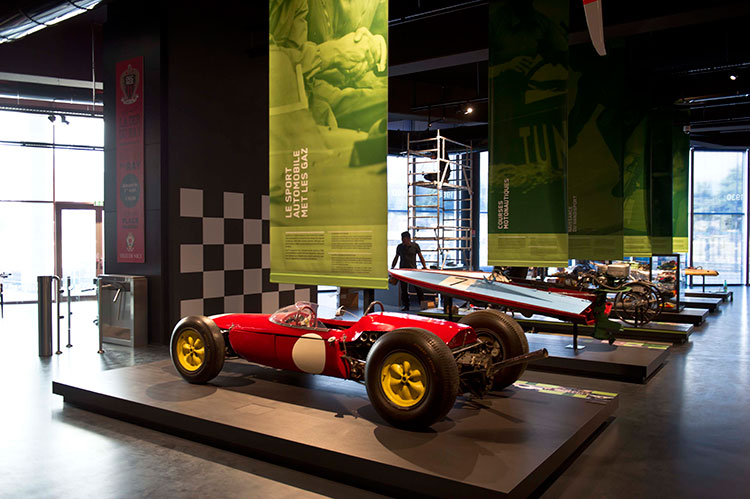
Just imagine: it took 35 articulated lorries to move the collection's 45,000 objects, 250,000 brochures and periodicals, 18,000 books, 110,000 photographs and 1000 films and sound tracks. More than 600 years of sporting history are told through some 100 sports, from the del duello fencing treaty of 1521 to rally driver Sébastien Loeb's racing overalls via Jean Borotra's Lacoste polo shirt (1920), the vest worn by athlete Jesse Owen when he broke three world records in 1935, the shoes worn by runner Emil Zátopek in the 1952 Helsinki Olympics, the radiogoniometer that Eric Tabarly used during his legendary 1964 transatlantic race, the bike Eddy Merckx rode in the final stages of the 1975 Tour de France...
A microcosm of society
But you don't have to be a sports fan to appreciate the exhibits, for sport is now a ubiquitous ingredient of contemporary society, its impact going way beyond that of physical prowess or wellbeing to become a fully fledged way of life with its own codes governing fashion, beauty, advertising, lifestyle magazines and the rest. It is this role that will be spotlighted. "It's society seen through the prism of sport, its history, its evolution, its tensions and its moments that have marked generations," Marie Grasse explains. How true, for we can't help but think of Nazi Germany on seeing the Olympic torch from the 1936 Berlin Games, of Edith Piaf's grief as we gaze at Marcel Cerdan's boxing shorts and gloves, of our national pride as represented by the racket with which Noah won the 1983 Roland Garros or the 1998 World Cup final football.
An interactive modern museum
A desire to appeal to all publics is evident too in the museum's very conception, in tune with the times. "We chose to tell a story by exploring the idea of challenge from four angles: challenging oneself, challenging others, the team challenge, and the challenge of pushing back limits." This narration is staged in a dynamic, graphic, interactive way so visitors relive the great adventure of sport through sound, video, QR codes to access multimedia content such as interviews and photos, plus hands-on activities including workshops and hi-tech simulators that let visitors see how fast they can cycle the Alpe d'Huez climb that's a Tour de France highlight, test their fencing agility or drive a Formula 1 car in the Monaco Grand Prix. Not forgetting what will surely be a huge favourite: two giant table-football games that can be played by teams of eight players!
 Côteweb 2021, création de site Internet sur Nice