


The MAMAC spotlights the Niçois artist who pioneered street art, for the last 50 years covering walls all over the world with his poetic, dramatic, conscience-tweaking images.
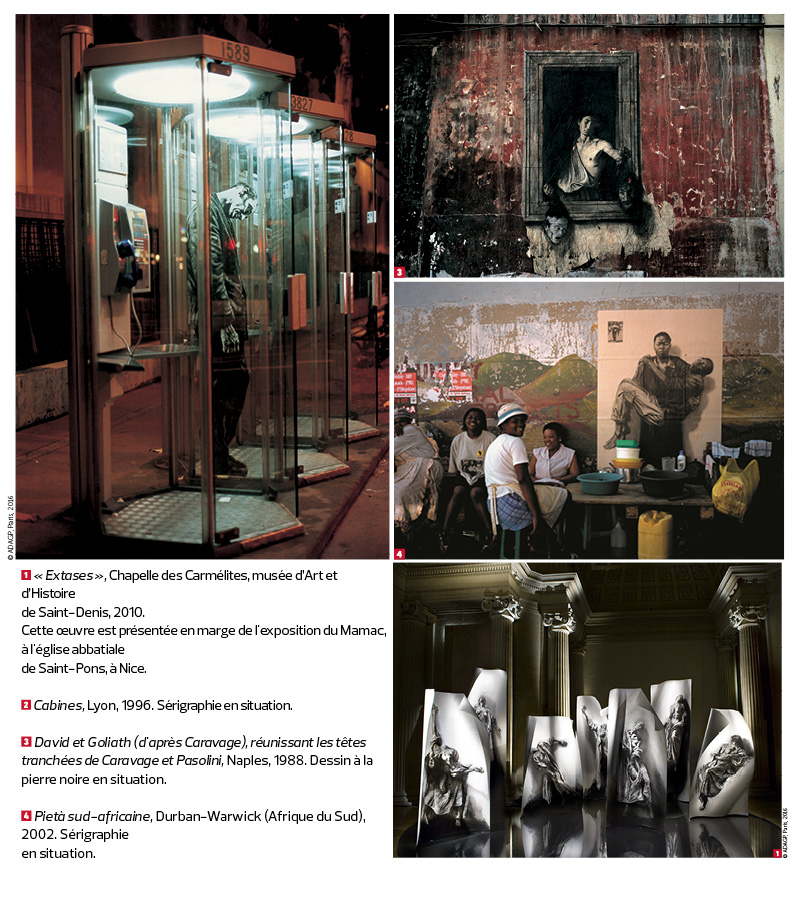
There's a big retrospective on Ernest Pignon-Ernest at the Museum of Modern and Contemporary Art in Nice, an exhibition that much more important since his images, remarkable in their aesthetics, powerful in their ethical content, fade over time in the streets that since 1966 he has chosen as his canvases, from Charleville to Paris, Naples to Algiers, South Africa to Chile. So sketches and outlines, preliminary drawings and photographs are the only lasting testimonies to an ephemeral art that reactivates urban histories buried, forgotten or trivialised. This accomplished scenic designer has divided his exhibition into three sections, and additionally uses the opportunity to show his Extases series of portrayals of Christian mystics in the Saint-Pons abbey church.
Recreating space and time on walls
Ernest Pignon-Ernest's first exhibition at the museum, 21 years ago, was devoted to his Neapolitan period. The present retrospective presents his street art and starts with an ecce homo piece created for Lyon prison in 2012.
He similarly references the Holy Shroud in his art. "Although I'm not a believer, the image of Christ's death has indelibly marked the history of art, and my work, which is always full-scale, incorporates that idea of imprinting. It's both a presence and an absence, like marks in the sand." Very much aware of the problems of his era, the artist covered the steps of the Sacré-Cœur church with depictions of bodies during the centenary of the Commune in 1971, and in 1974, scandalised by the twinning of Nice with Cape Town when the UN had just blacklisted apartheid as a crime against humanity, he inundated the town with images of a black family behind barbed wire.
Rimbaud's face, from Charleville to Paris
For the second part of his exhibition the artist has brought together three of his main themes: Naples; telephone boxes in Lyon and Paris, in which he painted figures isolated behind their glass walls; and Soweto
in South Africa, where he worked on the ravages of Aids in the townships. "I must have left 200 to 300 works around Naples. It was my way of questioning our Mediterranean culture; I was just as likely to work on a
church built as a Great Plague ex voto as on a 17th-century wall," explains the artist, who for each work explores the symbolism of the place plus its colour and light. His retrospective ends with a wonderful poets' room: Gérard de Nerval, Mahmoud Darwich, Rimbaud, Desnos, Artaud, Pasolini. "Picasso and Braque are essential to me but the poets have nourished my work. Through their lives and deaths they bear the stigmata of their times," the artist concludes.
 Côteweb 2021, création de site Internet sur Nice