


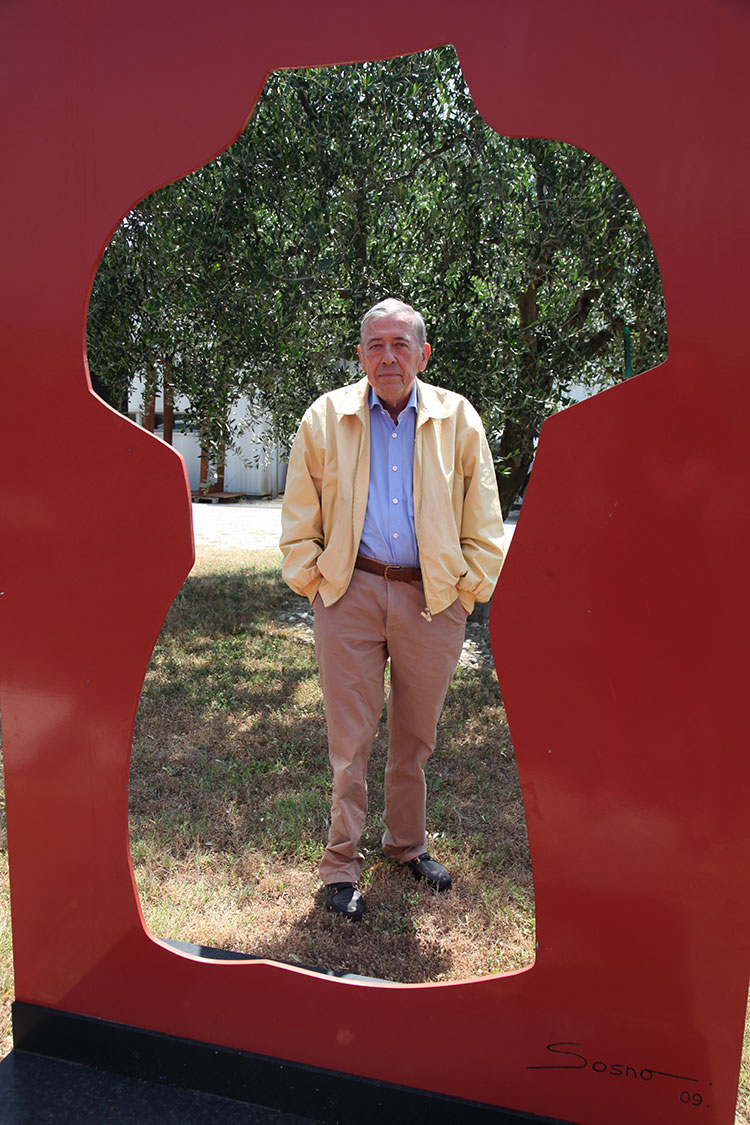
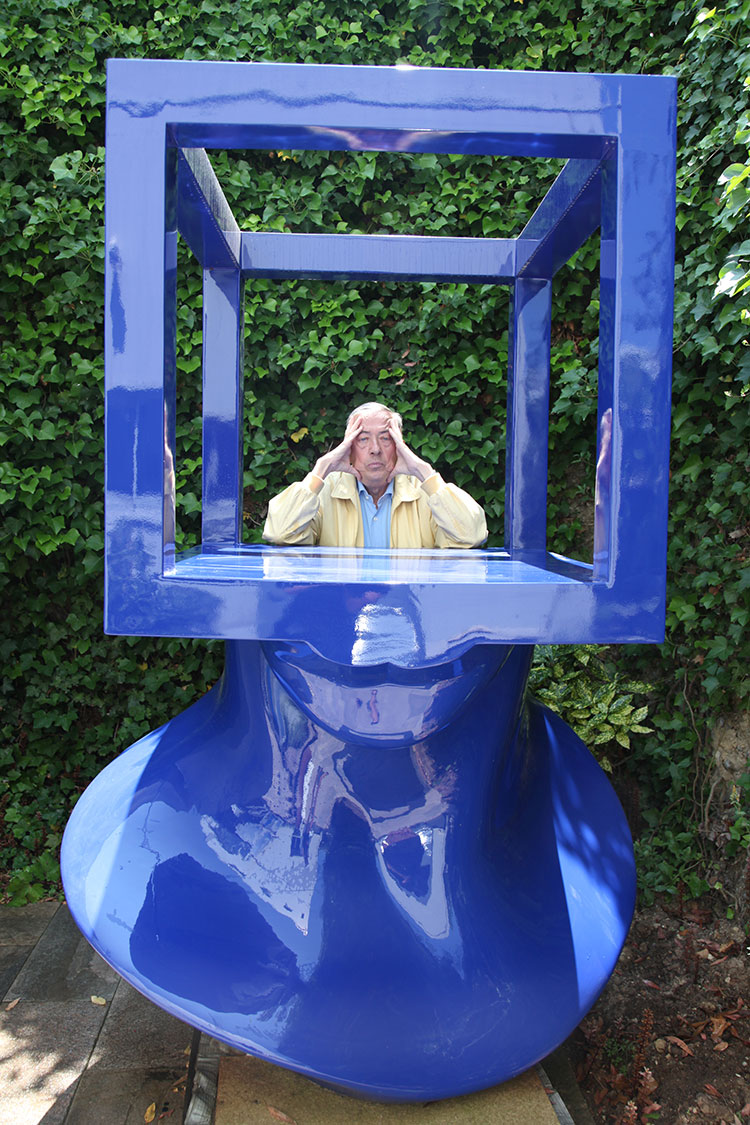
The Marseille-born sculptor with Lithuanian roots, a Niçois since childhood, dreamt of being an architect and wishes he had studied fine arts. From his unfulfilled desires were born a conviction, a talent and a signature.
As a child, Sacha Sosno had Henri Matisse for a neighbour. The painter saw nothing in the drawings young Sacha showed him, and the child's parents had a negative, old-fashioned idea of an artist's life, assuming it to be a bohemianism of alcohol and poverty. No matter! Sosno knew what he wanted and strove to achieve it. At 18 he went up to Paris to study at the Sciences-Po [prestigious school of political studies] but spent his time in the Louvre and the capital's art galleries. His vocation only grew stronger. Returning to Nice he met Arman and Yves Klein. He talks enthusiastically of the "Ecole de Nice miracle. In the 60s to 80s there was great solidarity between artists. Arman, Venet, Ben and the rest would introduce each other to the collectors, critics and journalists who came from Milan, Rome, Düsseldorf or New York. They helped me a lot. Today I've the impression it's "every man for himself" with the youngsters and I'm seeing that it doesn't work."
The soul of a builder
Sosno admits to possessing an "innate taste for the fantastic craft of the architect". He is as convinced as ever that "every artist should take to the streets, show themselves to the public". He elaborates: "Architects play a vital role in the city. Their work doesn't just have an internal function – housing, offices etc –, it has an identifying aspect too. If all city buildings were beautiful (as in Chicago, for example), towns would be open-air museums. And that would educate their inhabitants' eyes, subconsciously even." This specific viewpoint has guided his work and influenced his major pieces. "I love working with architects, but there has to be a joint signature so as to avoid conceits. Associates mustn't be disloyal to their partnership. I've worked mainly on building entrances, gardens and frontages, but my ideal is still the inhabited sculpture, like my Tête Carrée."
On politics
The Tête Carrée (square head) library, Sosno's best-known work and an emblem of Nice, is remarkable in more ways than one. "This project that won a national contest brought two distinct political entities of the day (1996) together. Which proves that from a certain point artists are obliged to have contact with politicians." And since he's as true to his convictions as ever: "In my interactions with politicians I never miss an opportunity to remind them that the Malraux Law isn't respected and I tackle each new Prefect on the subject of that "1% for art"* – after telling them I studied at Sciences-Po!" [laughs]. It isn't for himself that he does this. "Today I work for others. I'd like to promote a School of Art and Architecture in Nice, it could be called the Riviera Group. But that demands strong links of understanding and friendship between artists and architects."
From obliteration to inhabited sculpture
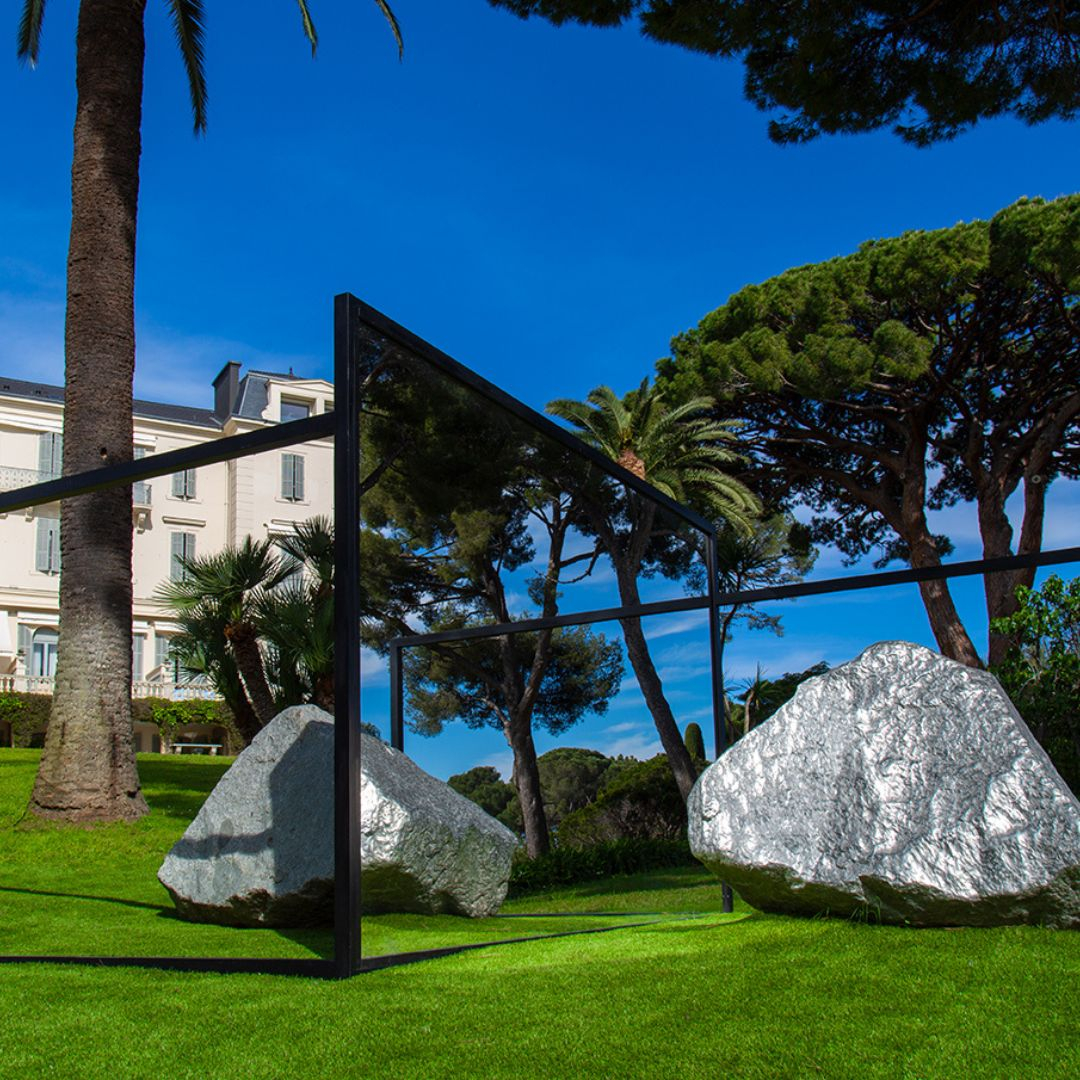
Like other great plastic artists, Sosno has developed his own language: obliteration. "It's about using holes to hide things, which makes the imagination work. It's considerably more exciting than revealing everything. You mustn't show everything, say everything. But making sculptures has become something of a daily round for me. What most motivates me are the long-term projects I'm working on for Korea, China, Russia. Unfortunately I now have fewer years than ideas available. In architecture the revolution is still to come. Inhabited sculpture is one line of thought: creating a form that has a use but also a sociological function. No longer art for art's sake. Frontages become galleries. In an economic recession it's these kinds of projects we should be looking at. Everyone has a role: the observer makes the artwork, the user makes the architecture, it's the eye that creates. So art is subjected to a permanent rereading. That's why I would like my work to last into the future a little, for people to say: he worked on two or three buildings that are still standing and firing our imaginations."
 Côteweb 2021, création de site Internet sur Nice